Introduction
I am a 169 cm, 22 year-old female with long legs. Today, I’ll draw a recap of my 1st training block (27/04 to 27/06) following a ‘K. Boges inspired approach’. In the following blog post, I’ll sum up some lessons learned along the way.
I pay for the ‘supporter subscription’. The notion of
‘physiological hygiene’ used by K. Boges really resonated with me. I wanted to develop a structured daily training habit. I listened to the ‘core concepts’ and watched videos from the exercise library, carefully taking notes; with this input, I started my practice.
In two months, my number of max. reps improved as follows. I went from 25 clean decline deficit
push-ups to 30. I went from 25 clean close grip push-ups to 30. I went from 15 clean Bulgarian split squats with 6 kg to 20 with 16 kg. I went from 28 clean bodyweight dips to 10 with 16 kg. I did not test my max. for bodyweight squats, because I have ‘iron legs’. I can walk the entire day in the hills where I live; I have lots of stamina in my lower body.
During this training block, my strength went up. I noticed it while strength training, but also during other activities. My swims improved: I can swim for longer and with less effort. When I walk, I use the glutes and hips muscles better. However, this might be because I have been specifically training my hip flexors as well as my obliques and paying attention to my spinal stability following Trainer Maxim’s advice (‘Get Gymnast Fit’ on YouTube). Finally, my muscles are more defined. I purposefully ate slightly above maintenance and gained about 1.5 kg in the process. I probably stay lean due to the amount of conditioning and cardio I do: I live an active life.
Context: training history and intention
I moved to a different country this year, being the third year spent away from the country I was born in. It was therefore a year of transition, and I personally find life being not the most comfortable when lifestyle changes occur: I like stability. I lived in the countryside without a car; this was ideal for my general conditioning. Everyday, I walked from 50 to 120 min. in a hilly landscape on a hiking trail to go to work and come back home. Walking has always been important in my life. It is one of the best conditioning tools: it is free and benefits both the brain, the body and the mind. I enjoyed it very much… although I will get my driving licence next year.
I worked a part-time job with random working times: I had no regular schedule from week to week, I sometimes worked 2 hours in the morning and 2 in the evening. This was a stressing factor in my lifestyle, but on the other hand, with some flexibility, I was guaranteed I could train every day.
Since I did not have a pull-up bar and my ceiling is too low for an indoor bar, setting up pulling exercises was not possible. I worked around it doing bodyweight rows on my gymnastic P-bars as well as kettlebell floor pullovers.
Prior to this training block, I had been training regularly for a few years, following the French ‘méthode Lafay’. I mostly did push-ups, dips, squats and lunges; first with bodyweight only, then with external weights. Especially, I used to do a lot of push-up variations, which help me build a strong chest. Pushing movements seem to be my strength.
I am a very active person and have a lot of stamina, both mental and physical. I like to swim (the outdoor swimming season is now at its peak!). I sometimes go for a run to clear my head. Where I live, many hills: it’s 45 min. continuously going up, then 10 min. flat, then 35 min. continuously going down. I do indoor bouldering in winter. I engage in physical activity for health; I am not competing, as I don’t specialize in one specific sport. Physical activity and movement are important for balance – they oil the body, oxygenate the mind and nourish the soul. Training is one of my happy mental places.
Training structure and exercise selection
I created two alternating workouts, A and B. I did each one 3 times per week, resting on Sundays. After a quick general warm-up, I performed 2 sets per exercise, always going very close to failure (-2, -1 or -0 RFEM).
My exercise selection was the following:
5 min. warm-up: 2 min. of duck walk + 3 min. of bear crawl, front then lateral (workout A and B)
Push: decline deficit push-ups (workout A) or close-grip push-ups (workout B)
Pull: bodyweight rows with elevated feet (workout A and B)
Squat: weighted Bulgarian split squats (workout A) or weighted goblet squats (workout B)
Finisher: horse stance (workout A and B)
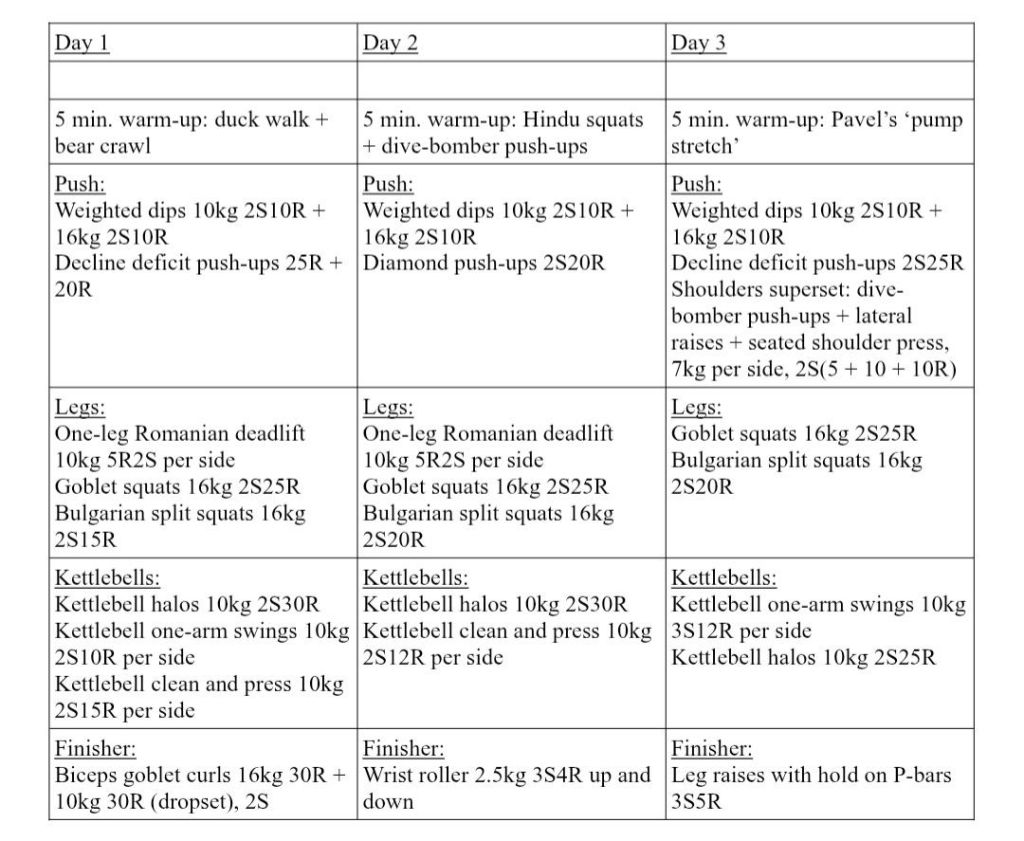
I made changes on the way: after a month alternating between workout A and B, I started studying kettlebell exercises from Pavel Tsatsouline’s books and slowly incorporated them into my routine. I now train every 2 days, so 3 to 4 times a week. Here is an example of a full week of training.
Evolution strategies
Next year, my lifestyle will change again. I’ll leave my hilly landscape and live in the city to finish my studies. Therefore, I will get less conditioning from walking. I would like to use this time to focus, on the one hand, on the pull-up. My max. now is 4 clean pull-ups with a shoulder-width grip performed at the climbing gym. I want to improve this number and eventually progress to weighted pull-ups. My goal for June 2026 is to reach 15 clean pull-ups. I am confident, since I have strong back muscles from swimming. On the other hand, I’d like to focus on strength work and increase my max. strength. I want to slowly make an evolution towards weighted calisthenics.
I already started adding external weights on the dips (16 kg kettlebell with a dip belt), and I am interested by Ian Barseagle’s ‘two sets method’.
In my opinion, ‘less is more’ for those seeking mastery. We should reduce exercise selection; the
most important is to remain patient, focused and consistent. I will probably divide (A) kettlebell and gymnastics training from (B) the pure ‘strength training’ part of my practice and treat them separately. In the near future, I also intend to keep my training log cleaner and less messy.
Personal lessons
First and foremost, the habit of a daily intentional movement practice became part of myself. It
helped me a lot to make it through this year in a new country, with a new job, and improved my health as well. My mixed approach, which incorporated gymnastic drills for better posture, improved my general body awareness.
On that topic, I want to stress out how important invisible muscles are for health. I learned a lot about the many tiny back muscles, the rotator cuffs, the hip flexors, the psoas, the diaphragm, etc. By ‘learning’, I surely mean reading about them to understand what these muscles are and which role they play in the body. But in matters of physical fitness, truly ‘learning’ means experiencing how it feels. ‘Learning’ is very practical: it means understanding what it feels like to have these muscles engaged while performing any physical activity.
In general, this training cycle helped me figuring things out: where am I at, why do I train, how do I want to train. What are my ends, and therefore what are my means to these ends? Three basic premises sum up my training approach. (1) I train for heath: I am not interested in ‘performance’ or competitive sports. I already experienced competitive sports during my childhood, and I don’t need to seek that experience again. (2) I order to train for health, I have balance in my training. This way, I train all the qualities of the body and I avoid any pathologic fixation on a given activity. When it comes to the type of physical activity I perform, variety is better than monotony. I need cardio and strength training to be healthy. (3) Balance does not equal ‘moderation’. Balance does not exclude excess: balance can be the result of two opposite extremes brought together. My training modalities result from these goals: I mix bodyweight with kettlebells, I avoid machines and gyms, I do cardio in nature. I train for conditioning and GPP to build a resilient mind and body.
To me, physical fitness is a strategical asset in my quest to build an active and self-reliant lifestyle. I can walk to the farm 4 km away from where I live to buy milk and meat, and then go back home feeling energized. My long-term ‘lifestyle goal’ is to live an active life close to nature: to have a garden and a cow for milk and to do things with my hands in order to provide for my own sustenance. Being free and independent from wage labour is a ‘self-reliance project’. Health of the body and mind through exercise plays a big part in such a lifestyle, since physical fitness is the first pillar of self-reliance. I don’t do exercise just for the sake of it. It is a means to an end and has a greater purpose (health).
Theoretical lessons
In order for a training strategy to be efficient in the long term, it has to be a solid but adaptive structure that evolves according to one’s circumstances and to the seasons. Here are three personal
examples. (1) During the holidays, I have longer periods of free time, e.g. a whole uninterrupted morning or afternoon: it is a good opportunity to study by reading books and practice drills or skills. (2) During the winter, we tend to do less outdoor cardio: less swimming, less biking, less running, perhaps rather walks and strength training. As a consequence, we accumulate a bit more body fat. In the summer, where the days are longer and the weather more clement, we tend to eat more fruit and veg and we are more active, therefore we look more ‘shredded’. (3) A good strategy for people who need movement to remain mentally sane while living in an urban environment could be based on ‘daily blocks’ of movement practice which bring structure to the day. Anyone can design training blocks during the day according to their needs and possibilities: it could be a ‘morning recharge’ with spinal drills or Pavel’s ‘pump stretch’, an evening stretching session, an evening walk, a mid-afternoon kettlebell session, pistols or pull-ups throughout the day to ‘grease the groove’, etc. I find it best to spread physical activity throughout the day.
There are many pillars of health: max. strength, flexibility, stamina, posture, breathing, etc. In my
opinion, the important part is to engage in different activities that are complementary, and do each
activity seriously and with dedication. A ‘healthy’ lifestyle is an active lifestyle; we are meant to be active all day long, not just ‘exercising’ one hour a day. The effects go beyond looking ‘good’ (that is, not ugly) or avoiding useless physical pain. This is not only ‘physiological hygiene’. When we are static, we get static thoughts. When we move, our thoughts are fresh and more alive, we avoid overthinking.
Hence, ‘physical training’ is much more than just ‘physical’. It forces your mind to focus on the motion, the movement, the body. Training isn’t something you can do mindlessly. You need focus and mental clarity. This helped me this year to avoid creating unnecessary mental stress in my day. Unnecessary lifestyle stress (noisy neighbours, living close to a busy road, problems at work) is terrible for recovery, but focus on what you can control and forget about the rest. Training gives a structure to my day: whatever happens during the day, I will train. Similarly, the permanence of my body through time gives a structure to my life as well: whatever in my life happens, my body remains with me.
Closing thoughts
James Pieratt (‘Wild Hunt Conditioning’ on YouTube) is a major inspiration to me. I’m interested both by his philosophy and by his training strategy: he uses unconventional strength training protocols to build a solid base for his ultra-endurance runs out in nature. Adam Sinicki, alias ‘The Bioneer’, has plenty of interesting videos for his YouTube channel. These inputs provide inspiration for designing one’s own training. In my opinion, what these two men have in common with K. Boges is a ‘natural’ training approach; this form of training is close to nature, it is free and is full of life. Thank you K. Boges for sharing useful resources online: they help to build ‘fitness independence’.
I’ll keep studying, training, learning new drills the next three years while I’m finishing my studies. You never know where what you do leads you: as I get my first stable job, I might train for an actual StrongFirst instructor certification. Training is, in my case, a solitary endeavour: I would therefore be very glad to read any tips and advice. And I’d love to see more women experimenting with K. Boges’ training approach.

